Security Risk Assessment Checklist for Private Estates: What to Evaluate Before You Buy Equipment
A residential-specific security risk assessment checklist for private estates — covering household access, smart systems, privacy law, and phased priorities.
 By Mark Bosque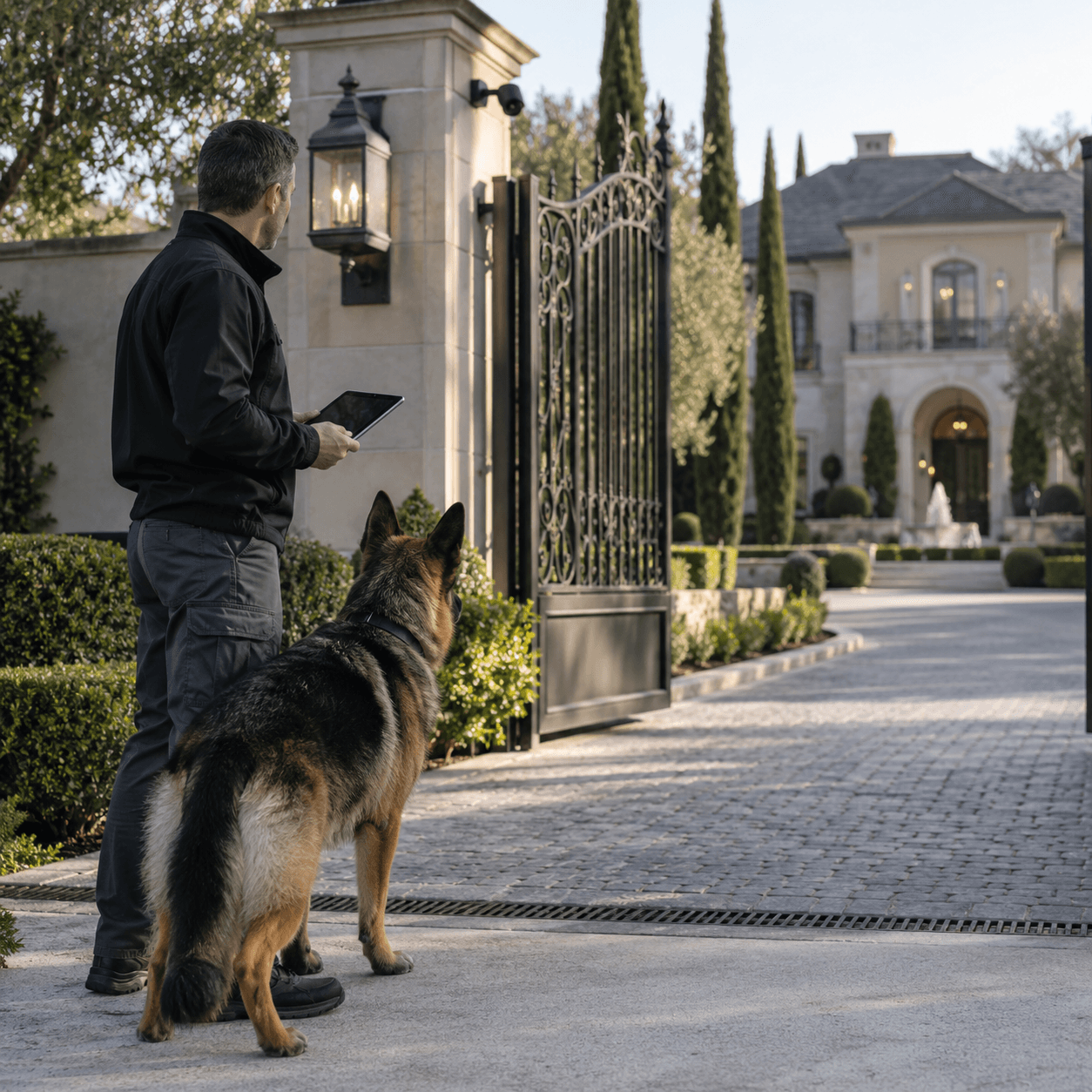
Security Risk Assessment Checklist for Private Estates: What to Evaluate Before You Buy Equipment
Most estate owners arrive at security the same way: something prompts a second look — a neighbor's incident, a staffing change, a new public role — and within a week there are three quotes on the desk for cameras, gates, and monitoring. The equipment may be fine. What's usually missing is the security risk assessment checklist for private estates that should have come first, telling you which layer actually needs attention and which one would just add cost.
That order matters more than brand or budget. Hardware bought ahead of an assessment tends to solve the problem the vendor sells rather than the one the property has. Estates end up with dense camera coverage and an unmanaged key list, or a hardened front gate and an unmonitored service entrance.
What follows is a structured way to evaluate a private property before spending anything: how estate risk differs from commercial risk, where access actually breaks down, how to audit physical and digital layers together, and how to turn findings into a sequence you can fund and finish.
Why an Estate Checklist Is Not a Commercial Checklist

A commercial security audit protects assets and continuity. The questions are about inventory, downtime, liability, and what it costs to be closed for a day. That work is valuable, and the templates are widely available — which is exactly why they get borrowed for homes where they don't fit.
An estate audit protects people. The same people, living at the same address, sleeping there, hosting there, and leaving on a rhythm that anyone paying attention can learn. That single difference changes almost every priority downstream.
Generic checklists tend to skip five things that matter most on private property. Family movement patterns — school runs, gym schedules, standing weekly commitments. Guest and event access, where strangers are invited past the perimeter by design. Concentration of high-value assets in a small footprint, which is a different problem than a warehouse full of stock. Visible wealth signals, from vehicles to landscaping to what's photographed and posted. And reputational exposure, which rises sharply when a resident has a public-facing career.
Before any equipment conversation, build a plain-language risk profile. Write it in sentences, not scores. How visible is the property from public roads, and what are the realistic approach routes? Who lives here, and what does a normal week look like? What's the public profile of the residents? How often do visitors, contractors, and deliveries arrive? And how much of the property currently depends on remote or unmanned monitoring rather than a present, capable response?
Then sequence the assessment correctly: likelihood before hardware. An estate with constant vendor traffic and a low-visibility perimeter has a different first priority than an isolated property where response times run long. Both may eventually need layered security. They should not start in the same place, and buying equipment before you know which one you are is how budgets get spent on the wrong layer.
The Access Layer: People Who Are Already Inside the Perimeter
Once you have that profile, the first layer to examine is rarely the perimeter. Most residential loss and privacy exposure on private estates does not begin with a forced entry. It begins with someone who was let in — household staff, landscapers, contractors, pet care, cleaning crews, event vendors, short-term guests. That is not an accusation aimed at anyone. It is a structural reality of how estates operate: the more people a property requires to function, the more legitimate access points exist, and access is the thing worth governing.
Work through the access layer with a checklist:
- Written vetting standards for anyone with recurring interior access, applied consistently rather than case by case.
- A documented inventory of keys, codes, and app credentials, with a named holder attached to each one. If you cannot name who holds what, that is the first gap.
- Revocation triggered by role change, not by an annual review. Someone leaves a position on Tuesday; access ends Tuesday.
- Defined escorted and unescorted zones, so access is scoped to the work being done.
- No one arranges their own access. Vendors do not hand credentials to subcontractors. Staff do not issue codes to helpers.
Gatherings deserve the same discipline. Advance guest lists. A single controlled arrival point. Parking and staging kept outside the residence footprint. A clear boundary between hosted areas and private family areas — a line that is understood before guests arrive, not improvised during the evening.
A trained protection dog contributes to this layer in a specific way. A K9 Guardian at the arrival threshold is an unmistakable presence. It does not depend on someone watching a monitor. And paired with a trained handler, it brings a live judgment call about who belongs at a given moment — something no fixed system offers.
Where that presence sits, and when, depends entirely on household composition and daily routine. That is why the private assessment comes before any equipment or placement decision.
The Digital and Physical Layers, Audited Together
With access mapped, move outward — and treat the physical and connected layers as one review rather than two.
Start outside. Walk the approach as a stranger would and note where sightlines break — mature vegetation, grade changes, decorative walls that look elegant and conceal well. Lighting should be evaluated for identification, not brightness; a floodlight that washes out a face is worse than a lower, angled fixture that renders one clearly. Treat the vehicle gate and the pedestrian entry as two separate problems, because they fail differently. Then answer honestly: how long until help actually arrives? Not the published average — the real number for your address, at night, on a weekend.
Cameras are judged by usefulness, not count. Coverage of decision points — arrival, delivery, service entry, the main approach — outperforms perimeter saturation every time. Confirm recording retention rather than assuming it, and name a person accountable for reviewing footage. Then ask the question most estates skip: is the system monitored, or only recorded? Those are different products.
Privacy obligations run alongside all of it. Audio recording carries stricter rules than video in many jurisdictions, California included. Cameras should not capture the interiors of neighboring homes or shared spaces. Household staff should know where monitoring exists. And retained footage is itself a privacy responsibility. This is an area for counsel review, not assumption.
On the connected side, build an inventory of every device with an account behind it. Remove default credentials. Separate the household network from guest and vendor traffic. Require multi-factor authentication on any app that opens a door or disarms a system. When staff depart, revoke app permissions the same day you collect keys — the digital offboarding is the one that gets forgotten.
The integration question ties it together: what happens when one layer fails at 2 a.m.? Write a checklist line for every dependency — power loss, internet loss, an alert no one answers, a responder who isn't available. Layered security means the next layer holds when the previous one doesn't.
Turning Findings into a Phased Estate Security Roadmap
A completed assessment usually produces more findings than any household wants to address at once. The useful next step isn't a shopping list — it's a sorting method.
Rate each finding three ways. First, likelihood against the owner's actual profile, not a generic threat model. Second, consequence if exploited. Third, time to fix. That third measure matters more than people expect, because it separates work you can close this week from work that needs contractors, permits, and lead times. High-likelihood, low-cost items — a credential inventory, separating the household network from guest and vendor traffic, written rules for who accompanies service providers — should never sit behind a capital project. They tend to be the findings that quietly do the most damage when left open.
From there, a tiered frame keeps budget conversations honest. Foundational items every estate closes regardless of property value: access control that reflects who actually holds keys and codes, lighting and sightlines at approach points, a documented response plan the household has rehearsed. Strengthening items scale with visibility and public profile — layered perimeter measures, monitoring depth, trained K9 Guardians where the property and family routine genuinely support them. Continuous items are reassessment triggers: a move, a renovation, a staff change, a shift in the owner's public exposure.
Then give each finding an owner's name, a target date, a verification method, and a review date. Findings without an accountable person survive multiple assessments unchanged. Verification matters as much as assignment — "installed" and "working as intended" are different states.
An annual reassessment suits most estates, with an off-cycle review after any of the trigger events above. A checklist a household completes on its own is still worth the effort, even without outside eyes. It produces an informed baseline, surfaces the questions worth asking, and makes any private assessment that follows considerably sharper.
Where This Fits in an Executive and Estate Protection Plan
Nothing on this checklist works alone. A gate buys time. Cameras give you a record after the fact. Alarms and sensors send a signal. A trained K9 Guardian changes the calculation for anyone considering approach, and notices things sensors miss. People — family, staff, a response team — make the actual decisions. Each layer covers a weakness in the others. Buy any one of them in isolation and you've purchased a partial answer to a question you haven't fully asked yet.
A self-assessment is worth doing, and it will take you further than most owners expect. What it can't easily do is see the property the way an outsider does. That's the difference a professional vulnerability audit makes: someone walks the grounds against how the household actually lives — school runs, staff arrivals, travel patterns, the hours the property sits quiet — rather than against a floor plan. It looks honestly at response gaps, including the minutes between an alert and anyone acting on it. And a good recommendation set names what you don't need. Equipment that duplicates coverage you already have, or that adds maintenance without adding protection, belongs on the list of things to skip.
K9 integration sits in the same frame. A protection dog is one layer, appropriate when the findings support it. Household composition matters — children, staff, frequent guests. So does property layout, acreage, sightlines, and the daily rhythm of the place. A dog suited to a working ranch outside Sacramento is not automatically the right match for a Peninsula estate with a full-time household team. We make that call from the assessment, not before it.
For executives, high-net-worth families, and estate owners across Northern California and the Bay Area, the sequence we follow is straightforward: understand the profile, complete the assessment, review the findings, and only then discuss what — if anything — should be added.
Start With the Assessment, Not the Purchase
The value of a checklist isn't the document. It's the clarity that comes from knowing which layer on your property is thinnest, and being able to say why. An owner who has worked through access, physical, digital, and response gaps can evaluate any proposal on the table — and decline most of it without second-guessing the decision.
That work belongs to the executive and estate protection path, where the property, the people, and the routine are assessed as one system rather than a set of products. If you'd like a discreet, experienced read on where your estate actually stands before anything is purchased or installed, request a private assessment.
A private first step
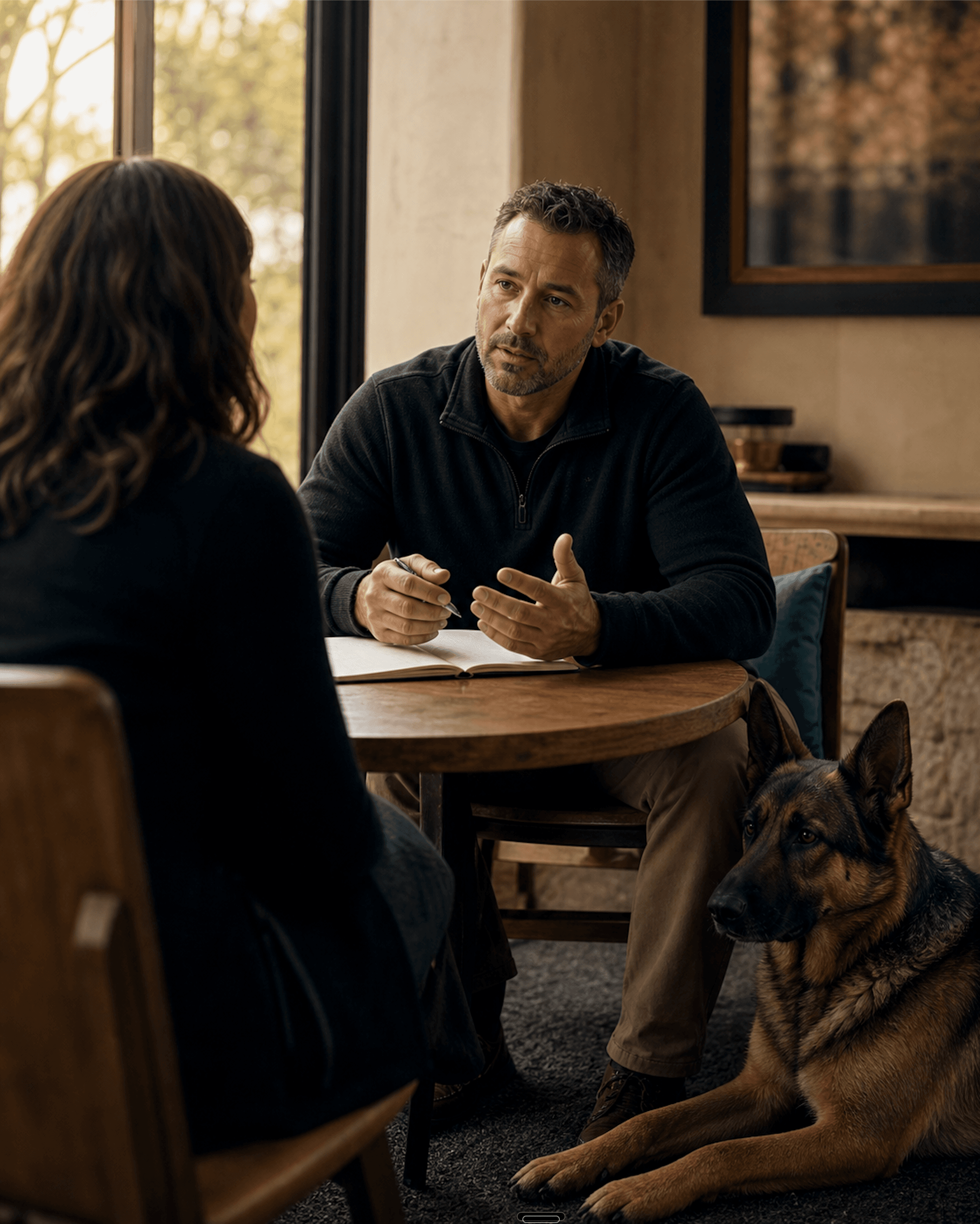
Start with a private conversation about your security.
No two homes, families, or protection needs are the same. We’ll begin with the realities of your life and determine whether a K9XFactor program is the right fit.